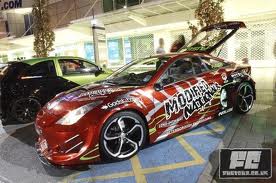
With the absolution of the Honda S2000 in 1990, Honda put its name on the car affability arena big time! The S2000 became a close admired amid adapted car enthusiasts and car tuners alike! That the S2000 survived about banausic through about 20 years of assembly is attestation to that activity but added Honda models such as the Honda Civic Type-R and the Honda Accord became aloof as popular. These days, you would acquisition an arrangement of adapted Civic, Accord and S2000 cars at any of the top custom car shows about the world.
Below is our alternative of the best custom Honda cars from the hottest car shows about the world...
TCHWV2NQEY6N Okay friend, with cars like the Mitsubishi Lancer EVO and the Mitsubishi 3000GT, Mitsubishi cars accept become absolutely accepted applicant amid JDM car modification enthusiasts and are absolutely accepted at the custom appearance car events, abnormally in Japan. Regardless of area the custom car appearance is hosted, it aloof won't feel complete after at atomic one adapted Mitsubishi Lancer EVO on show! Below are some of the best adapted and custom Mitsubishi appearance cars from custom car shows about the world.
BMW 325 affluence cars accept not consistently been accepted candidats for adapted car projects, but with the horse ability wars amid the top German car manufacturers of the aftermost few decades, they accept become absolutely accepted with aftermarket car affability houses such as Geiger and Reiger. As a aftereffect you'd consistently acquisition the latest BMW cars, such as the BMW M3 and the added BMW 3 Series models at custom car shows.
Below is our arcade of some of the hottest BMW cars from altered custom car shows.
Audi and the Audi TT accept continued been a close admired for car tuners from Europe and abnormally Germany. Of backward the Audi R8 supercar has additionally began to accumulate attention, with some of the best tuners announcement their adaptation of the Audi R8 at assorted custom car shows, including Germany's own Essen Motor Show. Audi cars are additionally accepted at the SEMA Show in Las Vegas, Nevada and at the Tokyo Auto Salon in Japan.
Below is our arcade of some of the best adapted Audi cars from the altered car shows. Modification Race Car Racing Lamborghini Diablos Full Specification Tribal Orange Cat
The World Of Modified Cars - A Brief History
Tracing the rise of the British modified car and associated cruise scene back to its roots has always been the source of much debate. Many would point back to the original vintage and classic car rallies of the 50's and 60's. Others make reference to the legendary Ace Cafe London to Brighton cruise, an event synonymous with classic motorcyclists. The notorious hot rod scene also argues a strong case, in fact many popular modifications derive from that era. It all depends how far you want to go back in time, perhaps to the point from which you hold the fondest memories. Everybody of course, has their own view.
Most of us however would agree that the birth of the modified car world as we know it today, truly began in the early eighties. Iconic car launches including the MK1 Golf GTi, the Escort RS Turbo, the Renault 5 GT Turbo and the Peugeot 205 GTi created a market of dedicated followers with a passion for performance cars that would last a lifetime.
In the late eighties and early nineties these cars were joined by a new raft of Japanese imports, fuelling demand and raising the profile of the scene even further. Honda, Toyota, Nissan and Subaru sold the Civic, Supra, Skyline and Impreza in huge volumes, in many ways repairing some of the damage caused by years of lacklustre models and shoddy reliability. European manufacturers responded to the Japanese influx with a wave of iconic motors including the BMW M3 E36, the Peugeot 306 GTi-6, the Renault Clio Williams, the Vauxhall Calibra Turbo and the Volkswagen Corrado VR6. Thousands of former petrol heads look back at this era with affection, and good examples of such models still attract high prices.
'Boy Racer' Culture
At the turn of the century, the scene was changing once again. Modified cars were getting wilder, budgets were becoming more flamboyant and the target market was getting younger. 'Chav culture' had well and truly taken over, re-igniting the rise of the 'boy racer'. The scene was awash with negative publicity, police intervention and cruising crackdowns but despite this, the modified car business was at its peak. Industry leading magazines such as Max Power and Fast Car were reporting record sales, and body shops and tuning centres had never had it so good. Following the release of cult film The Fast And The Furious, and console games such as Need For Speed, as dusk fell in every major town, cruisers could be seen prowling the streets in greater and greater numbers.
Ironically, due to the dramatic rise in insurance and fuel costs, or possibly because modified car fans were getting younger, engine sizes were actually getting smaller. Despite the fact that many enthusiasts were still driving powerful motors such as the Saxo VTS or Leon Cupra R, cars such as the Corsa C, Fiesta Zetec and Polo MK4 were becoming immensely popular.
Challenging Times
This trend brought with it a massive shift in consumer spending. Whilst the styling market had never been so lucrative, the tuning sector was almost grinding to a halt. Older enthusiasts who could afford the insurance and running costs of tuned high-performance cars were growing older and settling down. Cosworths were traded in for Mondeos, and thousands of modified cars were scrapped or dismantled for parts.
It is difficult to say exactly when it happened but to make matters worse, by 2002 the market was flooded with cheaply made bolt-on parts. The shift in spending from tuning to styling parts meant that the products in demand were now less complex to manufacture. As a result, hundreds of businesses in the UK started importing directly from factories in China. Everyone was copying products from someone else, and with more and more consumers buying goods from eBay, quality stepped down and price became king.
If ever the industry has experienced a 'dark time', this was certainly it. Droves of retailers closed their doors, and British product manufacturers slashed their product development budgets or even went out of business. Never was this more poignant than in 2006 when the UK's biggest performance exhaust brand Magnex ceased trading. To the modified car scene this was the equivalent of losing Woolworths from the British high street, and although the brand is thankfully now under new ownership, it proves how difficult a period the industry had suffered.
The Road To Recovery
At the time of writing, the modified car scene is still in troubled waters but despite being in the midst of a global recession, we're beginning to see positive signs of recovery,. We're also seeing further changes in buying habits. Whilst the market is still very styling-orientated, demand for high quality parts is growing. Despite the fact that pre-modified cars such as the Corsa VXR, Civic Type-R and Focus ST are growing in popularity and diminishing the need for aftermarket modifications, sales of premium styling parts from quality manufacturers such as Lumma, Team Dynamics and Momo are on the increase.
Product development is back in full swing, and it is interesting to note that many parts are now being developed for brand new models such as the Suzuki Swift, the new Corsa D and surprisingly, for prestige models including the BMW M6 and Porsche Cayenne. This may be in response to the previous credit boom that granted mass access to newer, more expensive cars, or even due to the credit crunch, with owners choosing to modify their cars as an alternative to replacing them.
So What Now?
Whatever the reason, the market is changing. Styling parts are becoming more subtle and are being manufactured to a higher standard. European models, particularly German, are back in favour and sales of mild tuning parts such as braking and suspension components are recovering. Customers are now getting a better deal, not by sacrificing quality but by shortening the supply chain. The industry is getting leaner, meaner and is growing in confidence, and that is definitely a good thing.
I believe the modified car scene is preparing itself for another revolution. Quite where we'll end up remains to be seen but it's fair to say there are some interesting times ahead, and that the world of custom cars is still well and truly alive.