Thursday, September 2, 2010

The 2010 Jaguar Sport Car XKR 75 will provide owners with exclusivity, excitement and a hint of Jaguar’s great heritage its debut at the 2010 Goodwood Festival of Speed on July 2. Jaguar Land Rover CEO, Dr Ralf Speth, initiated the challenge to the Jaguar engineering team to construct an XKR to celebrate Jaguar's 75th anniversary, which would deliver a combination of enhanced performance, superb chassis and steering control and grip levels to inspire the driving enthusiast to explore the true potential of the XKR's capabilities.
2010 Jaguar Sports Cars XKR 75
“The Jaguar Sport Car XKR 75 will provide owners with an exclusive, fun and a bit of the Jaguar heritage. This is a way to celebrate the power of the XK sports trademark name Jaguars 75 years,” said Mike O'Driscoll, managing director, Jaguar Cars.
Jaguar engineers increased the power and torque of the acclaimed 5.0-litre supercharged engine to 530PS and 655Nm respectively for the Jaguar Sport Car XKR 75, to deliver truly outstanding performance. While the limited edition model’s top speed is electronically limited to 174mph (280km/h), the Jaguar Sport Car XKR 75's 0-60mph (100km/h) acceleration time is reduced from 4.6 to 4.4 seconds compared to the standard 510 PS XKR. "We conceived the XR 75 as a sports car with a duality of character that makes it perfectly suited to driving across Europe to the Nurburgring, completing some very fast laps, and then driving home again, added Mike Cross, Chief Engineer Vehicle Integrity.
The Jaguar Sport Car XKR 75 features revised suspension and handling for increased precision and agility in addition to the performance enhancements. To ensure the XKR 75 remains stable at high speeds, a revised aerodynamic body pack with a front splitter, side sills extensions, a rear diffuser and larger rear spoiler provide increased balance and a reduction in lift. The XKR's computerised Active Differential Control also adjusts to reduce steering sensitivity at very high speeds, further improving stability and driver control.
Production of the Jaguar sports car XKR 75 is limited to just 75 vehicles, which will be available to order from July 2010 in the UK priced from £85,500 OTR. Customer deliveries will commence during October 2010.

While most cars designed to protect the environment look, at best, well-meaning, at worst, plain dull, the FIAT Bugster is designed to make saving the planet outrageous fun.

fiat_bugster_01.jpg

As might be expected when a group of Brazilians and Italians, two countries not renowned for their wall-flower tendencies, got together to produce a car under the “Environment and Fun” banner they came up with the FIAT Bugster – an all electric off-road car designed to be charged at home.

But, for a technical first, the Bugster is not so much mid-engined, as mid-batteried. The 93 Lithium-Ion batteries, being the heaviest part of the drivetrain, have been mounted in the middle of the car to provide optimum weight distribution to achieve the best level of handling and roadholding – issues that usually don’t trouble the minds of people designing hybrids and electric cars.

fiat_bugster_02.jpg

To make the most of its 59 kW and 220 Nm of torque, the electric engine is mated to the same Dualogic sequential manual gearbox as used in the FIAT Punto, so as to provide a sporty response and yet more fun.

Beyond the engine and the bright green paint there are many more ingenious ideas – the tools in the tool kit are made from recycled plastic reinforced with natural sisal fibres; the seats are made from foam produced with 30 per cent recycled soya bean oil and body panels use clay that had been modified by nanotechnology to make it suitable for car bodywork use.

fiat_bugster_03.jpg

Entirely built by FIAT’s Brazilian division, the Bugster makes its world debut this week (30 October 2008) at the Sao Paulo Motor Show and is the latest in FIAT’s long history of environmental advanced cars. FIAT, for example, produce for the Latin American market the first car to be able to run on four different fuels, the FIAT Siena Tetrafuel, which uses pure ethanol, a petrol/ethanol blend, pure petrol or compressed natural gas.

fiat_bugster_04.jpg

Not only is this unique car capable of running on each of the four fuels, it automatically switches to whichever energy source is most suitable for the driving demands being placed on it.

It’s no secret that Southern California is home to one of the best car cultures in the world. You can find a cruise or car show pretty much any day of the year, and it’s always amazing to see the vehicles that show up. It’s even incredible to see the kinds of cars that are simply out and about performing normal, everyday tasks. In addition to the usual Ferraris, Lamborghinis and Porsches, you can sometimes catch some truly unique cars out in the wild.

427batmo

Take, for instance, this original Batmobile that was out getting a wash and wax at the Car Spa in Newport Beach this weekend. It’s the fourth of four original Batmobiles built by George Barris back in 1966 and is known as the “dragster” version because of its 427ci Holman and Moody V8 under the hood and dual parachutes attached to the rear. The car was built to serve as an exhibition model and actually raced at several drag strips around the country back in the 1960’s. It also comes with a working saw blade that drops down at the front and can actually shoot flames out the back. We tip our hats to the fine gentleman that actually drives this thing on the street.

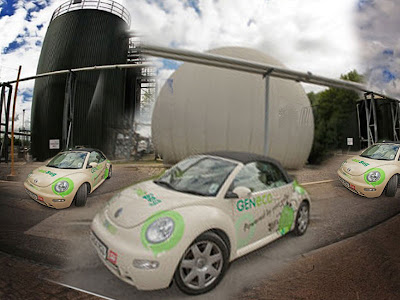
Mohammed Saddiq, general manager of GENeco, has another idea, which would take something that's normally thought of as waste, and turn it into a way to power a vehicle. The prototype  2010 VolksWagen Cars Beetle Bio-Bug is powered by methane gas which is produced from human waste at sewage works. Another environmentally friendly car has been shown to the world today by Wessex Water in England.
2010 VolksWagen Cars Beetle Bio-Bug Powered by Sewage Waste. The Bio-Bug is a project from Wessex Water, a sewage treatment company in England. Now there’s Bio-Bug, a VW Beetle that runs on the methane gas generated at a sewage treatment plant, reports The Telegraph. Wessex Water, near Bristol, England, says that human waste from the toilets of 70 homes can power the Bio-Bug for a year.
GENeco believes that more gas will be produced at its Avonmouth site when the company embarks on its latest green venture to recycle food waste. Mr Saddiq said: “Waste flushed down the toilets in homes in the city provides power for the Bio-Bug, but it won’t be long before further energy is produced when food waste is recycled at our sewage works.
At first glance, the Beetle appears to be a publicity stunt for GENeco, which owns a number of waste treatment sites in the U.K. But consider this: A single sewage treatment plant in Bristol, England generates 18 million cubic meters of biogas each year. The Bio-Bug squeezes out 5.3 miles per cubic meter of biogas. So just one sewage treatment plant could keep cars running for 5,400,000 miles each year, according to the British Daily Mail.
The Volkswagen Beetle dubbed the “Bio-Bug” was built for GENeco by UK’s The Greenfuel Company. The Bio-Bug’s 2.0-liter four-cylinder engine was converted to run on biogas and still hit about 114 miles per hour. However, the Bio-Bug uses regular unleaded gas to start, then switches over to methane automatically once it’s running. GENeco, a company owned by Wessex Water, supplied the equipment to treat the gas. “If you were to drive the car you wouldn’t know it was powered by biogas, as it performs just like any conventional car,” said Mohammed Saddiq, general manager of GENeco, in the release.
Mr. Saddiq explained that GENeco had been supplying treated compressed methane gas to generate electricity for the plant site and exported to the National Grid. The fuel for the Bio-Bug was surplus gas “we had available” and “we wanted to put it to good use in a sustainable and efficient way.”
The Bio-Bug was built by the Greenfuel Company, which specializes in converting gas cars to run on liquified petroleum gas.
2010 VolksWagen Cars Beetle Bio-Bug Powered by Sewage Waste
“The choice of car was inspired by students who took part in a workshop. They thought it would be appropriate that the poo-powered car should be the classic VW Beetle Bug because bugs naturally breakdown waste at sewage works to start the treatment process which goes on to produce the energy.”
Brilliant! Now, that’s a great marketing hook.


Hyundai will make a surprise at the Paris Motor Show 2010. Hyundai will display a minivan ix20. Hyundai ix20 will play in the MPV segment B. Hyundai developed and designed at Hyundai's R & D in Rüsselsheim, Germany.

Hyundai in official broadcasts showed a mini MPV that will present their latest offering at the Paris Motor Show. Sketches of cars that will be introduced as Hyundai ix20 that displays stripes design a more dynamic and sporty.

This mini MPV is the second product designed and developed at Hyundai's research and development centers of Europe in Rüsselsheim, Germany. Previously, this site has been born of Hyundai ix35 (or New Tucson in Indonesia), which both use the latest design of the Hyundai line, 'fluidic sculpture'. Although not yet given a detailed technical description, Hyundai claims if ix20 will offer a dynamic and fun driving.

Other products will also be introduced at the Paris is the New Hyundai i10. City car will get a better change in design, technical specification and also more competitive. With a 1.0 liter engine new, CO2 emissions generated claimed only 99 g / km.

Hyundai ix20 is the car a second after the Hyundai ix35 Hyundai embrace new design language, 'fluidic sclupture.
This car reflects the range of know-how diverse - a people carrier and fun-to-drive.


For safety, Ferrari finally issued a statement of withdrawal 458 Italia. After a disastrous few months that featured no less than five 458s inexplicably catching fire, the Italian supercar maker has finally conceded that there may, in fact, be something wrong with their new pride and joy.supercar maker has finally conceded that there may, in fact, be something wrong with their new pride and joy.

Ferrari finally issued the recall after discovering that a certain adhesive material they used to attach a heat shield under the car’s rear fender has the potential to catch fire when subjected to high temperatures, which, in turn, could lead to a fire in the car’s engine. From all the car’s rear fender has the potential to catch fire when subjected to high temperatures, which, in turn, could lead to a fire in the car’s engine. From all the photos we’ve seen of the burning 458s, each one of them looks to have taken place in the rear end of the car, which could indeed point to the adhesive as the main culprit behind the 458 barbecue fest.

To fix the problem, Ferrari has designed a new heat shield material that can replace the use of the defective adhesive by attaching it with rivets thereby completely removing the adhesive material that has caused all of these fires. So, if you happen to own a still-to-catch-fire 458 Italia, it’s absolutely a-must to contact your dealer as soon as possible and have this egregious problem fixed. You never know; if you don’t act quickly, that fire just might catch up to you and your beloved supercar.dealer as soon as possible and have this egregious problem fixed. You never know; if you don’t act quickly, that fire just might catch up to you and your beloved supercar.
From TS.


Though the new Shogun does a fair impression of a metrosexual, road-biased modern soft-roader, that atmospheric pressure readout in the centre console stands out like a crap-encrusted welly poking out the bottom of a smart suit. Dressed up in new clothes it may be - the facelifted Shogun gets a new front end that manages to be bluffer yet sharper at the same time - but this is still a river-wading 4x4 from the muddy old school. And better for it.

There is added grrr and green in the engine department. The 3.2-litre four-cylinder diesel has been revised, with power up to 197bhp, torque rising to 325lb ft and CO2 emissions dropping from 280g/km to a passable 224g/km. Consumption is improved by 5mpg. Of big SUVs, only the BMW X5 is cleaner.

With vital statistics like that, you'd be forgiven for lumping the new Shogun in with the modern breed of puddle-dodging faux-by-fours... until, that is, you start it up. At this moment, any delusions of a silky BMW-spec diesel disappear into the throaty rumble of the engine.

It'll haul the Shogun at a passable lick - 11 seconds to 62mph - but it won't do it with much enthusiasm. It will, however, enthusiastically pull large things out of bogs. TopGear has never been much concerned with towing capacity, but we are delighted to discover that the Shogun will haul a mighty 3,500kg. What is 3,500kg in hauling terms?

Well, it's plenty enough to drag a rogue cow from a peaty bog. Or a World War One tank come to that. The more expensive Toyota Land Cruiser will tow a pitiful 2,800kg. We imagine towing capacity to be important currency in the sort of grizzled, flinty pubs where Shogun and Landcruiser drivers drink.

As are things like front and rear overhangs, and maximum climb angles, and low-ratio gearboxes - stuff the Shogun does better than almost anything out there. Even this seven-seat version will tackle a 48° incline without breaking sweat. That's more or less upside-down.

The X5 or XC90 may defeat it over tarmac, the Discovery may offer a better balance of on- and off-road ability, but if your daily commute includes mamba-infested swamp and a plunging ravine with a dozen logs in tow, the Shogun is what you need. And those greener engine revisions mean you'll get deeper into the inky wilderness before reaching for the jerry can.


Specification
Cost
Price according to DAFTAR £ 37.999
There is no data transmission charges
12 Months Road Tax £ 125
Insurance group 16a
Running Costs (per mile) There is no data
Achievement
Maximum Speed (MPH) There is no data
0-60 MPH (Seconds) 0
Liters / 100 km (city) 9
Liters / 100 km (extra-urban) 9
Liters / 100 km (COMBINED) 11
Miles per gallon (urban) 22
Miles per gallon (extra urban) 31
Miles per gallon (COMBINED) 27
Emission
20 Euro emission standards
Carbon dioxide (CO2) 224

Technical
Door Number 5
Cubic capacipty (CCS) 3.200
Brake horse power (BHP) 197
Number 4 cylinder
DOHC camshaft
Number valve 4
Consumption of diesel fuel
Aspiration Turbocharged Fuel
Direct Injection Fuel Delivery
Especially Wheels Four Wheel Drive
Numbers Speed 2x5 teeth
Use Automatic Transmission